Amy Guy

Raw Blog

Sunday, December 16, 2012

Week in review: Not much again

10th December - 16th December

Boy, this Week in Review thing really highlights when I haven't done a lot, doesn't it?  I guess that's the point.

I spent most of the week not getting round to writing up and analysing my notes from the conferences.

We had an Ontologies with a View meeting.

I made a few connections and sent a few emails.

I did lots and lots of useful, but non-PhD-related things.  Honest.

Saturday, December 08, 2012

Week in review: Conferences

3rd December - 9th December

I went to the 1st International Open Data Dialogue (#odd12) in Berlin on Wednesday and Thursday, and gave a lightning talk at Digital Methods as Mainstream Methodology (#dmmm2) in London on Friday.

Both were brilliant; I met a ton of interesting people, learned loads and gained much inspiration.  My extensive notes are in the process of being typed up and thought about, and will be published on here as soon as humanly possible!

Now I'm going to catch up on sleep that crack-of-dawn flights and many hours of train journeys have denied me recently.

Monday, December 03, 2012

Week in review: Not much

26th November - 2nd December

I read a paper about Semantic Web tools for online communities.  Large parts of this project are comparable to my own, I think, and I will probably keep going back to it for inspiration.

I did a lot of non-PhD related things, too.

Wednesday, November 28, 2012

Advice: willful misunderstanding, and audience as individuals

Picked up on some great advice during an afternoon-long course entitled 'How to do an Informatics PhD' a couple of weeks ago.

All through my undergraduate, and probably High School as well, I was told that when writing assignments I should treat the person marking it as if they don't know anything at all about the subject.  They're stupid.  Leave nothing unexplained.  Of course, we were often also told to 'keep things concise' and usually had to do this under the constraints of page or word limits.

Problematically, some people could have interpreted this as an opportunity to try to pull the wool over their marker's eyes, or baffle them with science.  Typically, the marker will know something about the subject, so that's probably not a great tactic.

I see where this advice comes from of course, and a couple of weeks ago I heard it phrased in a different way, that makes far more sense.

The examiner will be knowledgeable about the subject, but given to willful misunderstanding of what you're trying to say.

I think that gives a much better guide to how and when to explain things.  And also makes them more of an enemy to be conquered, than an inconvenient fool to be deceived.

And whilst I'm recounting advice I like, here's something that has stuck with me since 2010, from my manager at Google at the time.

When presenting to a large audience of people, don't think of them as a crowd.  Think of them as many individuals.  Make your presentation as you would to a single person.  It just so happens that there are lots of single people there all at the same time.

Since letting that sit in my subconscious, nerves before giving a presentation have shrunk to negligible levels.  It may be that over the past two years I've become more confident anyway, but I used to be thoroughly terrified of standing up in front of even a classroom of people the same age as me.  I wouldn't talk out in lectures for the most part of my undergraduate, and harbored a gut-wrenching fear of being picked on to answer a question.  As did most people, I imagine.

I make sure to actively observe how I feel when watching someone else present.  I look at other people in the audience too, and note the attitude and techniques of the presenter.  (Consequently I probably leave having no idea what the presentation was about).  The results are usually that a majority of people aren't listening properly.  A vast proportion certainly aren't angrily judging the presenter's every twitch.  Things people notice and get upset about include:

  • If they can't hear you.  
  • If you're just reading off slides, particularly if you try to act like you're not.
That sure is a short checklist of things to avoid.  There must be more that can go wrong.  Reasons people will stop listening, include:
  • If they can't hear you.
  • If you're just reading off slides, particularly if you try to act like you're not.
  • If they're not interested in what you're talking about. (Pro tip: make them interested).
  • If you're not making any sense at all.
  • If your slides are more interesting than what you're saying. (I really like presentations without slides.  So long as the speaker is engaging, of course.  Slides with lots of words are a definite negative, in my book though).
And some of my personal nitpicks include:
  • Drawing attention to a mistake by apologising for it.  From being on both sides of this situation, it usually feels right to do so at the time, but until you do, four fifths of the room won't have noticed, and the fifth that did will forget within the next few seconds.  Point it out, and everyone will remember.
    • If you say something wrong, just correct yourself and move on (but don't leave it uncorrected, this is usually noticeable).
    • If it's a technical problem, keep talking whilst it gets sorted.  This boils down to not relying on technology to keep your presentation interesting.  I am aware that there are some situations where this is impossible.
  • Weak intros and outros.  I've been guilty of both of these.  I plan to pay more attention to upcoming talks in order to fix this.  It's something I always forget to notice.  But for now:
    • Starting with filler words, like 'So, ...', 'Right then...' or 'Okay, ...'.
    • If you've been introduced, you don't need to repeat it, especially not in a way that draws attention to the fact you're repeating it. 
    • Make it clear when your talk is done.  Don't trail off with '...and that's that then.'  'Any questions?' is usually okay, but only if it follows a distinctive final sentence.  Jumping to that from what feels like half way through a paragraph is a bit rubbish in my head, but in all honesty will probably go unnoticed by the audience.  Except me.

Fortunately, my days of feeling agonisingly self-conscious whilst presenting are long gone.  On top of that, I find doing as little 'rehearsal' as possible boosts the natural fluidity of a presentation, and in turn my confidence.  If I haven't rehearsed, there's nothing to forget to say (and suddenly forgetting what comes next is the biggest killer of flow, something I discovered during French oral exams).  That only works if you're very familiar with the subject matter.  And if you're not, you probably shouldn't be presenting about it.


Disclaimer: I'm very early in my academic career, and haven't presented a whole lot.  The biggest audience I've talked in front of was about 120.  Despite the theory, I suffer from having neither a naturally loud voice, nor a naturally beaming expression.  So all round, I'm probably not very good.

Monday, November 26, 2012

Notes about Semantic Web tools for online communities


K. Faith Lawrence & Dr. Monica Schrafel (2007)  Amateur Fiction Online - The Web of Community Trust: A Case Study in Community Focused Design for the Semantic Web. Intelligence, Agents, Multimedia (IAM) Group, School of Electronics and Computer Science, University of Southampton.

NB. Need to read her full thesis, of the same name.  Will probably clear up some of the questions I scribbled whilst reading the paper.

Finding out if Semantic Web tools can be brought to hobbyist groups on the Web.
  • Uses the online fiction community; suggests they could benefit from:
    • improved searching
    • improved meta data
    • automatic recommendations
    • trust webs
    • personalisation.
  • A HCI project, so usability tests and comparisons with current systems are key.
Related work
  • Community centered design
    • to determine user needs - through continual interactions and user studies.
    • to consider how reader-facing apps present themselves and particular community
      • responsibility of being a portal - need clear affordences and points of failure.
  • Trust and Semantic Communities
    • The semantic web “provides a common framework that allows data to be shared and reused across application, enterprise, and community boundaries.” - Tim Berners-Lee, James Hendler, and Ora Lassila. The semantic web. Scientific American, May 2001.
    • Do we trust:
      • metadata
      • data
      • mechanism by which data is returned
      • person requesting data?
    • Many definitions of trust.
    • Jennifer Golbeck's trust onotology to go with FOAF (Jennifer Golbeck, Bijan Parsia, and James Hendler. Trust networks on the semantic web. In Proceedings of Cooperative Intelligent Agents 2003, 2003.): ratings of 1 - 9 for trust of associates.  Extended for FicNet (this paper) 
    • Here, trust: "the expectations that arise that an individual will not act in a way that is detrimental to another individual or community."
      • I might need to expand that for my stuff... maybe... maybe this will do.
Case study
  • Community predates the Internet. (duh)
  • Necessary to get opinions from people outside of the amateur writing community, because it is broad. Such as parents/guardians of members.
  • Questionnaire
    • General information
    • Reading habits
    • Community involvement
    • Access and distribution of materials
  • Questionnaire distributed by:
    • requests to archives to pass on to members
    • LiveJournal
    • emails to specific interested parties
    • mailing lists / bulletin boards of relevant special interest groups.
  • In two weeks, 1116 responses, from 30 countries.
  • Used to inform ontology design for FicNet, and OntoMedia.
Fan Online Persona (FOP)
  • Extension of FOAF, tailored for needs of online readers and writers.
  • foaf:person -> fop:persona
  • Separates environments for on and offline
  • fop:NomDe - context for name
  • Illusion of anonymity is fundamental to fanfic community (who are a large part of online amateur writers)
  • Most authors have one or more pseudonyms.
  • 80% said email address is the most personal information they should be asked for.  ('of the 80%, 15% said no personal information should be requested from anyone - does this make sense? Do they mean other than email address?  but that's the 80... If they're in the 80, they can't be part of that 15...)
  • Privacy is the main thing holding back FOAF (Joseph Smarr. Technical and privacy challenges for integrating foaf into existing applications. Presented at 1st Workshop on Friend of a Friend, Social Networking and the Semantic Web, September 2004.)
  • Personas aren't meaningless, because people become very attached to them, and only create new ones for specific reasons (says who? No citation..)
  • Expands foaf:document and foaf:groups
  • Creation, exchange and review of works is the point of these communities.
  • FOP dismisses FOAF info like work and school as irrelevant or potentially dangerous.
    • [Me]  I think the on/offline divide won't be so extreme for many amateur film makers (another story for consumers) because often their faces are in their movies... Also anecdotal evidence from my own experiences that I'm open to having proven to be a minority.  Actors vs characters is an interesting distinction too.  One amateur film maker can have many personas, even across one channel of output.
  • Options for FOP determined through long term study of metadata commonly attached to works. (Something I can do, too).
Trust
  • FilmTrust by Golbeck (just joined, it was closed last time I looked).
    • Could be prettier... but 2169 members!
    • Visualisations of the network - I need to get good at this.
  • Reader has to trust info from author falls within a certain level of accuracy.  In amateur writing, it is more acceptable to be over cautious than lenient.  Differing standards of acceptable content.
    • Less trust is lost if a story is underrated than overrated (resulting in disappointment)
    • A minority mislabeling work has a big effect on reputation of an archive/community (HelpingHands community members. A place to pitch in and help - a website creation resource and project. LiveJournal Community, 2005.)
  • Writer has to trust reader to make the right decision.
  • FicNet has a more specialised trust system than Golbeck's.
    • Largest contention in this field is adult material and younger readers (debated because this contrasts with IRL - no restricted areas in book stores, or suitability rating scheme for books).
    • Initially focussed on age.
    • Personas could vouch for each other.  Creating fake personae to validate another wasn't worth payoff?  Non malicious statements of distrust?
    • How to integrate trust and distrust webs?
Future
  • Ontologies developed, ready to be used by applications!
    • Ontologies will be continually refined.
    • Now designing applications.
      • Using info already gathered via quesitonnaire, re: UI, functionality.
  • Integrate with OntoMedia to describe works, and link works with people.

=> How did they get to talk to the parents of younger users?  Did they ask the members to put them in touch?  That doesn't seem like a realistic expectation to have, to me..

Week in review: Pancakes & Project management

19th November - 25th November

I read two papers about ontology development methodologies.

I read two articles by Bennett Haselton about decentralized social networking, which happened to pretty much sum up and beautifully articulate everything about that that has been floating in my subconscious for a couple of weeks.  I saw links to them in the latest Circumventor email, which I've been subscribed to since High School for bypassing the internal blacklist, and remain subscribed to because the jokes at the end are always laugh-out-loud funny.


I attended an all day course entitled 'practical project management for research students'.

  • It was attended by a diverse bunch of seemingly really lovely people.
  • The two ladies running it, from the IT Project Management department in the University, were lovely too.
  • The stuff covered was all obvious, common sense stuff (and pleasantly the organisers didn't try to claim otherwise) - but sometimes it's helpful to have it all written down and waved in your face.  And structured, in particular.  Made me actually focus on thinking about organising my project.  The main thing I hadn't much considered, even subconsciously, was formally identifying stakeholders for a project and their relative interest/power in the project.
  • There are a bunch of tools at projects.ed.ac.uk to aid in project management.
  • It prompted me to do these week-in-review posts, as I realised I haven't been recording properly everything I've been doing (an overview of my time goes on my calendar, but no detail).
  • The sandwiches weren't great, but fortunately when I got back to the Forum there were massive slabs of chocolate cake left over from some event.  I love the Forum.
I booked a place at the 1st International Open Data Dialogue in Berlin, and necessary flights.
  • Despite the short notice, it worked out logistically because I need to be in London on the 7th anyway, so I can simply go to London on the 4th, fly to Berlin from there for the 5th and 6th, and back to London for the 7th.
  • I'm particularly looking forward to "Open Statecraft: Openness as a Means (not an End)" by Philipp Müller, "The Open Data Movement vs. Business Models - is this a Contradiction?" by Dr. Peter A. Hecker, "Linked Open Data @ W3C-Vocabularies, Working Groups, Usage Scenarios" by Prof. Felix Sasaki, "The potential of Open Data for improving urban sustainability" by Dr. Marianne Linde and "Towards Trustworthiness: Establishing Transparency with Open Information Flows" by Dr. Edzard Höfig.
  • I'm also looking forward being in Berlin again, even if it is just for one evening, and I'll probably be too exhausted to appreciate it.
Ontologies with a View took place at a different place and time to usual.
I started preparing for presenting at Digital Methods as a Mainstream Methodology in London in a couple of weeks.
  • I scribbled lots of notes.
  • I skimmed a few papers by organisers/speakers but didn't read any in detail yet.  Mostly stuff about analysing data gathered from comments, tweets etc. 
  • There will be more about both of those things next week, I imagine.
I made a plan for the two weeks following the 20th.
  • It mostly consists of finishing my Digital Methods preparation.  I have a lot of non-PhD related things to do as well, plus lots of travelling.  Also graduation from my MSc, and subsequent parental visitation will get in the way.

Wednesday, November 21, 2012

Notes about ontology creation methodologies (2 papers)

Yesterday I unexpectedly read two whole papers about ontology development methodologies.  They were open in tabs I don't remember opening, but presumably did so during our weekly Ontologies With A View meeting last Friday.  There are still a bunch more tabs open with papers or articles about the same thing, so maybe I'll read those later..

The notes are here more or less as I scribbled them down whilst reading, and I haven't expanded with any analysis or discussion as of yet.

Notes in purple are things I intend/need to investigate further; colour-coding is just for me, really.


Jean Vincent Fonou-Dombeu & Magda Husiman (2011)  Combining Ontology Development Methodologies and Semantic Web Platforms for E-government Domain Ontology Development.  International Journal of Web & Semantic Technology (IJWesT) Vol.2, No.2, April 2011 

  • Start by describing ontology in a human-readable way, then turn to RDF (etc) to be machine readable.
  • Says there's not sufficient practical research around existing technologies or ontology development guidelines that would allow non-experts in e-government domain to make ontologies.
  • Uses framework from Uschold & King (see later in this post) to describe ontology - technique used here should be platform independent.
  • Then uses UML to semi-formally represent ontology
  • Uses Protege and Jena to convert to OWL and RDF
  • Paper's goal is to produce guidelines for e-government developers to create semantic content AND strengthen adoption of Semantic Web technologies in governments (particularly developing countries).
  • Outlines RDF, OWL, Protege and Jena (described as leading platforms; mentions other platforms: WebODE, OntoEdit, KAON1, Sesame).
  • Very critical of other literature; either ontologies have been produced but no practical information given; they've been developed with proprietary platforms; or they're only conceptual and don't say how they could actually be constructed with existing technologies.  other studies have not focused on a methodological approach, which means nothing is easily repeatable.
  • Detailed comparative studies of methodologies in:
    • M. Fernandez-Lopez, “Overview of Methodologies for Building Ontologies, ” In Proceedings of the IJCAI-99 workshop on Ontologies and Problem-Solving Methods (KRR5), Stockholm, Sweden, 2 August, 1999. 
    • H. Beck and H.S Pinto, “Overview of Approach, Methodologies, Standards, and Tools for Ontologies,” Agricultural Ontology Service (UNFAO), 2003. 
    • C. Calero, F. Ruiz and M. Piattini, “Ontologies for Software Engineering and Software Technology, ” Calero.Ruiz.Piattini (Eds.), Springer-Verlag Berlin Heidelberg, 2006.
  • Case study: Ontology for monitoring development projects in developing countries (OntoDPM)
    1. Create with Protege:
      • class heirarchies
      • slots
      • domain and range of slots
      • Based on the UML
      • Saved as OWL
    2. Then put content in RDF with Jena

Mike Uschold and Martin King (1995*) Towards a Methodology for Building Ontologies. Workshop on Basic Ontological Issues in Knowledge Sharing, IJCAI-95.
  • Steps:
    1. identify purpose
    2. build ontology
      • capture
      • coding
      • integrating existing ontologies
    3. evaluation
    4. documentation
  • Purpose
    • Many ontologies are intended for reuse
    • Should survey purposes to clarify options for future projects
  • Building
    • Capture
      • Identify key concepts and relationships in domain of interest
      • Produce unambiguous text definitions for these
      • Identify terms for these
      • Agree on all of the above
    • Coding
      • Explicit representation of conceptualisation in a formal language (choose a language)
    • When can capture and coding stages be merged?
    • Differences between building ontology and creating a general knowledge base (thinking about methodology will help with this)
    • Integrating (during either or both of above)
      • Work must be done in agreement between communities
      • Make explicit all assumptions underlying an ontology
  • Evaluation
    • Judge against requirements specification (and/or)
    • Judge against competency questions (and/or)
    • Judge against real life
    • This paper looks at knowledge base systems, and adapts for ontologies.
  • Documentation
    • Desirable to have established guidelines for documenting
    • Main barrier to effective knowledge sharing is inadequate documentation
    • ALL important assumptions should be documented
  • Case Study
    • Main emphasis is on capture phase
    • Initially:
      • define ontology (Gruber)
      • identify users and usage (initially abstract, then clarify with real life)
      • choose language (Ontolingua was chosen)
      • choose method for capture - BDSM (IBM) supported by others:
        • KADS
        • IDEF5
        • OO Analysis and Design techinques
        • Gruber's principles for ontology design
    • Categorisation is fundamental to the human condition (Lakoff)
      • Not heirarchical, but:
        • GENERAL
                 ^
             BASIC  ->  primary with respect to knowledge organisation
                 v
          SPECIFIC
        • eg.
                SUPER:   Animal    /   Furniture
                BASIC:    Dog        /   Chair
                SUB:        Retriever /   Rocker
        • Certain concepts used subconsciously, rather than understood intellectually.
          • These have a more important psychological status.
        • Therefore paper uses middle-out approach to capture terms
          • (bottom-up = too much detail unnecessarily,
          • top-down = risks imprecision)
        • BASIC concepts first because:
          • most important
          • used to define non-BASIC terms
          • increase clarity, especially for non-technical use
          • backed by BSDM experience of paper author
  • Scoping
    • Brainstorming
    • Consult corpora if there aren't enough domain experts to brainstorm
    • Grouping
      • structure terms into naturally arising sub-groups
      • collate synonyms
      • consider things that might refer to each other
  • Meta-ontology
    • Don't commit too early, can restrict thinking.  Let concepts and relationships themselves determine requirements.
    • Be consistent.
    • Use technologically neutral language ('thing' vs 'entity').
    • Start with areas where there's most overlap.
    • Work from basic terms to more abstract ones within an area.
  • Producing definitions
    • Agreeing on definitions (varying degrees of problems)
    • Handling ambiguous terms
      • clarify ideas without technical terms
      • use a dictionary!
      • label definitions, eg. x1, x2
      • determine most important concept
      • choose a term, avoiding original ambigious one
    • Avoid new terms
    • Terms get in the way (peoples' preconceived ideas) - concentrate on underlying meaning and concepts.

Friday, November 09, 2012

National Novel Procrastinating Month

It's day nine, and I'm on two thousand, eight hundred and seventy words.

A quick calculation might tell you that that means I'm quite behind schedule.  This may be my worst year yet.  There's still plenty of time to get back on track though!  Right..?!

I've only spent any time writing on about three or four of those nine days so far.  But I have been to a conference, organised some SocieTea events, read bits and pieces related to my PhD, cleaned my flat, watched a few episodes of Arrested Development, learnt some new crochet stitches and started crocheting a hat, and baked a lot.

I did meet the Edinburgh NanoBeans and had a great time at the write-in in Pulp Fiction last Wednesday.  We may have spent more time collaboratively developing the backstory of Pedro the Guide Bear (a troubled young grizzly attired in an Elvis costume and boater hat who constantly struggles against his estranged father, Yogi, the leader of an organised crime syndicate) than actually writing our novels though.

I have learnt one particularly important thing this year, that's never come up before.

Talking ideas through with other people is really useful!  

Last Sunday, Beth helped me explain the absence of a main character's mother and fix a potential looming plot hole with one fell swoop.  Telling Kit about the various civilisations and layout of the land in my world allowed him to pick holes and question things, raising, and partially solving, some things that didn't make sense or yet more potential looming plotholes.  And Caitlin (a new NanoBeans writing buddy) pointed out that just because a character had been anticipating reading a letter for the last thousand words, didn't necessarily mean the letter had to contain anything interesting... it could be a disappointment to the character... which helped, as I hadn't figured out what the letter said, and all of a sudden the character was opening it.

I sure wish blogging about Nano counted towards the word count.

Monday, November 05, 2012

Remediating the Social #elmcip

I spent the last few days in Edinburgh College of Art, helping out at the Remediating the Social conference.  I was in charge of making sure everyone's microphones were on, and slides were being projected, which turned out to be more work than anyone anticipated.  Only minor hiccups occurred though, usually when I unplugged something I shouldn't have by accident.  I couldn't have done it without my glamourous assistant José, who was the master of fiddling with Macbook screen resolutions to make them play nice with the projector.

More importantly, I saw some super interesting talks, and met and talked to some fantastic smart people about electronic literature, and other things.

I also presented about Palimpsest, in front of the biggest audience I have ever talked in front of.  Go me.

Videos of everything from the conference are here.

On the last day I implemented an idea that had been kicking around the back of my mind for a while, which was the Uninformative Twitter Wall, or Twitter Squares.  It's nothing particularly complex; it uses jQuery and probably has memory leaks.  I'd love for people to help themselves to the code and improve it. Converting a hash of a tweet text into a hex code, I generated coloured squares for the results of a search term.  If the feed you choose is updating a lot, then the squares move around quickly and it looks pretty funky.  If there are only occasional new tweets, then it looks less exciting, but is still equally useless for seeing what people are saying.  (Unless you hover over the squares).  That's okay though, because it's Art.

Wednesday, October 31, 2012

National Novel Writing Month

That's write right, it's the eve of Nanowrimo.

Last year, my MSc got violently in the way and I clocked out at about 15,000 words.  I'm hoping that this year, my PhD will make friends with my month of literary abandon, and both will come out better for it.

I stumbled into a new world last May, wandered around and met some characters over the summer, and have been mulling over them ever since.  I put pen to paper to draw a map today, and discovered that more of the world was there than I thought.

I have three viewpoint characters, and next I'm going to draw some squiggly lines on a piece of paper to figure out where their paths cross, and what might happen to them along the way.  Over the years I'm becoming more inclined towards plotting in advance, but a large part of me never really thinks it'll help.

I've been reading A Song of Ice and Fire, and am now gagging to create a world with half as much depth and drama as GRRM has done.  Mine will be fantasy, with a hint of sci-fi and a dash of Ancient Egypt (probably no medieval knights).

This year I'm going to work in yWriter in an attempt to keep on top of things as I expand settings and characters.

I'm hoping to attend more than just the launch party for the Edinburgh Nanobeans group this time round.  Though they do meet across the wrong side of town, so I might also start my own write-ins (consisting of just me) in Himalaya Cafe on South Clerk St. (it's ever so comfy, and the chai is the best).  If you're writing too, and in that neck of the woods, come and join me.  I'm tentatively saying I'll be there between 10 and 11am every day (except Sunday, they're closed), starting on the 5th.  (This is going to cost me a fortune in chai, isn't it..)

Stay tuned for progress updates.  Or lackthereof.

PS. I know I promised notes on papers related to my PhD... One day.  One day.


Monday, September 17, 2012

University 3.0

Even though I don't officially start my PhD until the 1st of October, today really felt like a proper first day of term.  I got up early went to a couple of fourth year/MSc classes that I've decided to sit in on (HCI and Text Technologies), went to training for tutoring/demonstrating, filled in some forms, got my new student card (that doesn't expire until 2016!) and most importantly, got the key to my office in the Informatics Forum.

My PhD ideas are vague at best right now, though it'll definitely be within the realms of the Semantic Web.  According to the proposal I wrote to apply for the position back in May, it'll be to do with provenance of and collaborative creation of digital media artefacts, like comics and films.  It'll be interesting to watch that morph and change.

Though I became aware of Semantic Web stuff during my undergraduate, I developed my knowledge during my MSc at Edinburgh.  Primarily by taking the Multi-Agent Semantic Web Systems course for credit, enjoying it a lot and doing pretty well.  (I should be TAing/marking for that this year).  I also learnt lots about linked data and other such things at conferences and hacks like Dev8D, and various open data meet-ups.  I'm super excited about the future of the Internet - particularly making sure it remains an open, public platform for uncensored expression and knowledge sharing (fingers crossed).  Since I'm a technologist, not a lawyer or policy-maker, I have to address this with theoretical and practical research around how people create and share things, and ways to improve connectivity (between people and data), which of course includes the big problems like privacy, security and identity.

Whilst I'm confident enough to say I know quite a lot about designing and developing for the Web these days, my Semantic Web knowledge really consists of a basic grounding, and a lot of enthusiasm.

There's a ton of research going on in various related areas, so I've decided to read one or two relevant academic papers a day... forever, I guess... and make notes on what I read.  Publishing my notes here works as a subconscious stimulant, to make sure I actually get it done.  A lot of them might be foundations, or basic stuff, but I intend to cram as much as possible - especially in the couple of weeks before I start propertly.  So look out for those! (If you're interested.  If not, ignore them).

Wednesday, June 13, 2012

Shifting focus (from readers to authors)


By sheer coincidence, I find myself neck-deep in creating a custom Interactive Fiction engine during a year in which all kinds of new engines for authoring and enjoying interactive narrative are popping up. Many of these by established programming and literary experts in the IF community.

It feels like every week Emily Short posts a review of something new. Most of the ones I've seen recently are more of a Choose Your Own Adventure format than parser-based. Nonetheless, there is a lot I can learn about world modelling and code-free authoring from these systems. Not all of them are open to the public for creating though. All of them seem to be open to Emily Short, however, and she is doing a great job of describing and reviewing her experiences.

It occurred to me a while ago that creating the interface for authoring pieces for Palimpsest is potentially more interesting and important than examining the reader experience when it's all done. Readers are much more fickle, and those who spend time writing and creating are by definition the committed and passionate. I'm not saying the readers aren't. But a solid interface for authoring is going to make it much more likely that good experiences for readers are to be created. If I rush through the design and build of the software itself so that I can focus on filling it with content then quizzing readers about the immersiveness of their experiences - as was my original plan - there's a good chance I won't spend nearly enough time testing with authors (as I'll be doing the authoring) and will miss the opportunity to allow people to create immersive or particularly engaging experiences, jeopardising the outcomes of the user study stuff in the end anyway.

I only have about two months left to work on this in the context of my MSc. Whilst I need something substantial to fill my final report with, I'm certain I'll be continuing to develop this in the future, and I'll only end up having to redo bits from scratch if I cut corners the first time.

I also have to think about what I want to get out of my MSc, and how I want to use the opportunities I have studying in an art department compared to what would be expected of me studying in a computing department.

I jumped on the idea of 'user study stuff' because I know how to do this in terms of software, and I know how to write a lot about it.  Not that I don't find the immersion thing interesting, but overall I think it would be more valuable to both myself and any eventual users of Palimpsest if I produced documentation of detailed musings about the perhaps unfinished or forever-ongoing development of a custom engine and authoring interface for Interactive Fiction, rather than gloss over that to fill my report with lots of nice statistics and quotes and analyses about reader experiences that are ultimately invalid anyway.

And I can do this for an 'art' project, where the journey is equally, if not more, important than the outcomes.  Where for a 'computing' project, the documentation of the journey has in my experience generally been intended to be a build up to an overarching theoretical or practical conclusion.

So next up, look out for a discussion of the various engines for different flavours of interactive narrative that have been popping up / I've been noticing recently, coming soon to a blog near you!  (This one.  This is the blog it'll be coming to.  Not any old blog near you).

Thursday, May 24, 2012

Character sketching


Suddenly I find myself having to write some fiction to a deadline.  A deadline that isn't Nanowrimo, that is.  This isn't something I've had to do since my English language GCSE.  I deliberately avoided pursuing creative writing in any formal or academic manner, for fear the joy would be sucked from something I love; for fear it would become a chore, or an obligation.

But this semester I've imposed this on myself out of determination that my supposedly 'interdisciplinary' masters actually deviate from Web or software development at some point.  Not that making writing fiction a part of my final project has in any way reduced the programming.  Indeed, I've just added it on top of an already substantial project outcome.

But making an Interactive Fiction engine feels much more valuable if I actually write some fiction for it, doesn't it?

Suddenly, realistically, I have mere weeks to get this done.  My subconscious has been working on it since about December of last year, but I haven't had many committal thoughts.  So it's time to make (and justify) some decisions.

I already decided that, quite obviously really, the piece needs to revolve heavily around the city of Edinburgh.  (Obvious, as the reader will be experiencing it whilst wandering around the city, and I'm studying the affects of physical environment on immersion in a text).  As such, I figured doing research about local myths and legends, particularly stories relevant to specific places, is pertinent.  Look out for updates on that.  Historic and mythical local characters might be useful too.

Ian Rankin has famed the Edinburgh streets with his novels, but I'm no crime writer, nor mystery nor thriller.  I write science fiction and fantasy; imagining new worlds comes far more naturally to me than conjuring stories in this one.  And my time is too short to venture into an unfamiliar genre.  So this leaves me trying to figure out how to set a story on the real world streets of Edinburgh whilst maintaining a fantastical element so that I keep my sanity and confidence in the prose.

One potentially helpful aspect of Interactive Fiction, is that generally the stories are written in the second person.  The main character is a perspective taken by the user/reader/player.  This means there is a primary role that I don't have to develop too much as a character.  Just enough to fit in with the context of whatever plot starts to develop, but with adequate openness to allow the user to project themselves into the character's place.  Nonetheless, I'm going to need some attachment to this character in order to engage myself in the writing process.  I know from experience that I'm far less motivated to write about/for characters who don't interest me, but when I discover a character I feel really involved with, I miss them and desire to write more.

That's the interesting point, really.  I don't feel much as though I'm writing characters or their stories, but discovering them and learning about them through the writing process.  I've lost control of characters before; they've behaved unexpectedly or undesirably, sometimes even changing the whole course of a previously loosely planned plot. The same might apply to imaginary places or even objects.

Because I don't have time to find a fresh character, world, setting that I love, I have concluded that I need to hook this story back to something I've written in the past.  Something I'm already invested in.  This connection is only meaningful to me (until the glorious day the still unfinished, few-year-old novel gets published!) so it needs to be loose.  But enough to give me context.  The connection I have settled on is Milo's World, the subject of my 2008 Nanowrimo; my only successful attempt at reaching fifty thousand words in thirty days, though I have yet to write the ending to the story.  Also part three needs rewriting completely, those were dark days.  Not to mention the rest of it.  But that's neither here nor there.

The important thing is, I met a couple of characters with whom I had great fun.  I hung out with them for massive chunks of their childhoods.  I learnt what makes them tick, and I learnt their secrets.

The point-of-view character in Milo's World is Dusty.  I first met him as a four year old, and quickly discovered he had access to a secret world, where he regularly snuck off to play with a boy his own age, Milo, who seemed to live full-time in this world.  They had all sorts of innocent adventures, and gradually met other occupants.  I spent time with Dusty and Milo again aged eight, to find that not much had changed.  They had befriended some strange creatures, and were privvy to experiences they could not understand yet.  At age twelve, they were growing up.  Dusty has gained a few home-world friends, has developed an amazing talent for drawing caricatures, and his parents have long since assumed that he's over the 'imaginary friend' stage.  But his grip on their 'reality' is disjointed.  There are more kids around in Milo's world, living in a network of tunnels and working and playing together, and with the creatures of the world.  One species of creatures in particular have introduced curious technologies and ways of thinking.  When Dusty is sixteen years old, he is balancing regular high school drama with other-worldly adventures, but just barely.  He and Milo are working with one of the creatures to learn about a contraption that they played with in their youth, and have dubbed The Reality Machine.  Using it is hit and miss, and many of the things they find out about it, they learn the hard way.  When Milo's world and Dusty's home-world begin to bleed together through misuse of the Machine, things start to take a turn for the confusing.  Cue the hilarious, semi-cliffhanger ending, strongly linked with Dusty's drawing skills, I haven't written yet.

So where am I going with this?  In my Palimpsest story, Dusty is grown up.  Long since grown up.  He is old, mad-scientist-proffesor-ly, and living in a world that bears the consequences of his actions as a child.  Right away we have the existence of and ability to cross between alternative realities (via an understood and controllable Reality Machine, in case you hadn't cottoned).  Splendid.  I'm in my comfort zone already.  So how about... the playable character is Dusty's lab assistant.  Their age, gender, appearance, don't matter.  Their temperament matters probably only a little bit.  What matters is the fact that they have the ability to zip around in space and time.  Whaddya know?  Every single exciting era of Edinburgh's history is open to us to explore.

All I need now is a reason Dusty might have sent his assistant across to Edinburgh in our version of reality; something to pursue, something to figure out.  Or just a malfunctioning Reality Machine.

I call this a start.

As always, comments and suggestions welcome!

Thursday, May 17, 2012

Stylesheet organisation

About a year and a half ago I realised I needed to get a grip on how to organise my CSS.  I established a template, which I proceeded to change drastically with every new project.  I noticed recently that I've been reusing a version for the past few projects, with at the most only minor amendments to the general structure.  I also noticed how quickly I'm rolling out initial designs using this template.

I have finally reached the point where I figured out what I consistently reuse across projects, and finally have a stylesheet structure that makes such intuitive sense to me I can dart around and make changes with my eyes closed.  I find my stylesheets are much smaller, but even as they grow, I still know exactly where everything is.  I wish I had some statistics to quote about the amount of time spent scrolling through CSS looking for things.  I'm confident it is much reduced.

Some aspects of my workflow I developed through intuition; I made changes that felt right to me at the time, without really consulting anyone else's best practices.  Other things I picked up from here and there.  Every now and again I'd search for 'the right way' of doing this and find processes and systems that didn't gel with me (a primary example of this being the number of pre-built grid systems I tried and hated).  Eventually I would give up under the sheer number of contradicting points of view, but I probably picked up some subconscious inspiration on the way.

I hadn't thought much of this until Chris Eppstein talked about this at FOWD today.  A lot of the suggestions he demo'd are very similar to parts of my system (conceptually at least; he was discussing SASS and mine is raw CSS).  So I figured it's reached the point it is worth sharing.

First things first, I start with a basic Initializr stylesheet; a couple of minor tweaks, but then I largely accept the helper classes and IE fixes and hacks (no need to read this; it's just here for completeness):


/* ======================================================================
HTML5 Boilerplate CSS: h5bp.com/css
========================================================================== */

article, aside, details, figcaption, figure, footer, header, hgroup, nav, section { display: block; }
audio, canvas, video { display: inline-block; *display: inline; *zoom: 1; }
audio:not([controls]) { display: none; }
[hidden] { display: none; }

html { height: 100%, font-size: 62.5%; -webkit-text-size-adjust: 100%; -ms-text-size-adjust: 100%; }
html, button, input, select, textarea { font-family: sans-serif; color: #222; }
body { height: 100%; margin: 0; padding: 0; font-size: 1em; }

::-moz-selection { background: #fe57a1; color: #fff; text-shadow: none; }
::selection { background: #fe57a1; color: #fff; text-shadow: none; }

a { color: #00e; }
a:visited { color: #551a8b; }
a:hover { color: #06e; }
a:focus { outline: thin dotted; }
a:hover, a:active { outline: 0; }

abbr[title] { border-bottom: 1px dotted; }
b, strong { font-weight: bold; }
blockquote { margin: 1em 40px; }
dfn { font-style: italic; }
hr { display: block; height: 1px; border: 0; border-top: 1px solid #ccc; margin: 1em 0; padding: 0; }
ins { background: #ff9; color: #000; text-decoration: none; }
mark { background: #ff0; color: #000; font-style: italic; font-weight: bold; }
pre, code, kbd, samp { font-family: monospace, serif; _font-family: 'courier new', monospace; font-size: 1em; }
pre { white-space: pre; white-space: pre-wrap; word-wrap: break-word; }
q { quotes: none; }
q:before, q:after { content: ""; content: none; }
small { font-size: 85%; }

sub, sup { font-size: 75%; line-height: 0; position: relative; vertical-align: baseline; }
sup { top: -0.5em; }
sub { bottom: -0.25em; }

ul, ol { margin: 1em 0; padding: 0 0 0 40px; }
dd { margin: 0 0 0 40px; }
nav ul, nav ol { list-style: none; list-style-image: none; margin: 0; padding: 0; }

img { border: 0; -ms-interpolation-mode: bicubic; vertical-align: middle; }

svg:not(:root) { overflow: hidden; }

figure { margin: 0; }

form { margin: 0; }
fieldset { border: 0; margin: 0; padding: 0; }
label { cursor: pointer; }
legend { border: 0; *margin-left: -7px; padding: 0; white-space: normal; }
button, input, select, textarea { font-size: 100%; margin: 0; vertical-align: baseline; *vertical-align: middle; }
button, input { line-height: normal; }
button, input[type="button"], input[type="reset"], input[type="submit"] { cursor: pointer; -webkit-appearance: button; *overflow: visible; }
button[disabled], input[disabled] { cursor: default; }
input[type="checkbox"], input[type="radio"] { box-sizing: border-box; padding: 0; *width: 13px; *height: 13px; }
input[type="search"] { -webkit-appearance: textfield; -moz-box-sizing: content-box; -webkit-box-sizing: content-box; box-sizing: content-box; }
input[type="search"]::-webkit-search-decoration, input[type="search"]::-webkit-search-cancel-button { -webkit-appearance: none; }
button::-moz-focus-inner, input::-moz-focus-inner { border: 0; padding: 0; }
textarea { overflow: auto; vertical-align: top; resize: vertical; }
input:valid, textarea:valid {  }
input:invalid, textarea:invalid { background-color: #f0dddd; }

table { border-collapse: collapse; border-spacing: 0; }
td { vertical-align: top; }

.chromeframe { margin: 0.2em 0; background: #ccc; color: black; padding: 0.2em 0; }

/* ===============
    ALL: IE Fixes
   =============== */

.ie7 #title{ padding-top:20px; }

/*******************************************/
/*                                         */
/* My styles go here!                      */
/*                                         */
/*******************************************/

/* =============================================================================
   Non-Semantic Helper Classes
   ========================================================================== */

.ir { display: block; border: 0; text-indent: -999em; overflow: hidden; background-color: transparent; background-repeat: no-repeat; text-align: left; direction: ltr; *line-height: 0; }
.ir br { display: none; }
.hidden { display: none !important; visibility: hidden; }
.visuallyhidden { border: 0; clip: rect(0 0 0 0); height: 1px; margin: -1px; overflow: hidden; padding: 0; position: absolute; width: 1px; }
.visuallyhidden.focusable:active, .visuallyhidden.focusable:focus { clip: auto; height: auto; margin: 0; overflow: visible; position: static; width: auto; }
.invisible { visibility: hidden; }
.clearfix:before, .clearfix:after { content: ""; display: table; }
.clearfix:after { clear: both; }
.clearfix { *zoom: 1; }

/* =============================================================================
   Print Styles
   ========================================================================== */
 
@media print {
  * { background: transparent !important; color: black !important; box-shadow:none !important; text-shadow: none !important; filter:none !important; -ms-filter: none !important; } /* Black prints faster: h5bp.com/s */
  a, a:visited { text-decoration: underline; }
  a[href]:after { content: " (" attr(href) ")"; }
  abbr[title]:after { content: " (" attr(title) ")"; }
  .ir a:after, a[href^="javascript:"]:after, a[href^="#"]:after { content: ""; }  /* Don't show links for images, or javascript/internal links */
  pre, blockquote { border: 1px solid #999; page-break-inside: avoid; }
  thead { display: table-header-group; } /* h5bp.com/t */
  tr, img { page-break-inside: avoid; }
  img { max-width: 100% !important; }
  @page { margin: 0.5cm; }
  p, h2, h3 { orphans: 3; widows: 3; }
  h2, h3 { page-break-after: avoid; }
}

My template is inserted into the appropriate point of the Initializr stylesheet.  I divide into five sections:

/* 0 Accessibility */

/* 1 Typography */

/* 2 Colours & borders */

/* 3 Spacing & layout */

/* 4 Images & video */

I start each section with empty media query clauses for 480px and up, 768px and up, 1024px and up, and 1200px and up.  By the time a project is done each section will typically have from one to six media query breakpoints in it, according to requirements.

0. Accessibility

A staple of this so far is:

/** 
 0 Accessibility
**/
.no-css {
 /* This class hides stuff that needs to be around for screenreaders or users with no CSS, but not in normal circumstances */
 position: absolute; left: -1000px;
}

Which I chuck in when I use visuals to enhance some content, to hide an appropriately positioned textual equivalent.

There's probably more useful stuff that should be here. I'm working on it. (Suggestions welcome!).

1. Typography

Not a lot going on here. Some obvious placeholders, plus a couple of classes I found myself needing over and over, which should be self explanatory (.win and .fail are applied to success or error messages; usually a form submission is involved).

/**
 1 Typography
**/

h1 {}
h2 {}
h3 {}
h4 {}

p {}
a { text-decoration: inherit; }
a:hover { text-decoration: underline; }

.note {
  font-size: 1em;
  font-weight: bold;
  text-align: right;
}

.wee {
  font-size: 0.8em;
}

.win, .fail {}


In typography, I strictly only include font stuff like faces, sizes, alignment, decoration and enhancements like text-decoration, font-weight.

2. Colours and borders

Border styles go here because they need to be defined before the border colours are. Otherwise, just colours go here:

/* Borders */
  .win, .fail { border: 2px solid; }

/* Dark */
  .dark { color: #2d2d2d;}
  .dark-bg { background-color: #2d2d2d; }
  .darker{ color: #000; }
  .darker-bg { background-color: #000; }

/* Primary Color */
  .color1 { color: green; }
  .color1-bg { background-color: green; }
  .color1-border { border-color: green; }
  .color1-texture { }

/* Secondary Color */
  .color2 { color: yellow; }
  .color2-bg { background-color: yellow; }
  .color2-border { border-color: yellow; }
  .color2-texture { }
  
/* Tertiary Color */
  .color3 { color: red; }
  .color3-bg { background-color: red; }
  .color3-border { border-color: red; }
  .color3-texture { }

/* Light */
  .light { color: #ccc; }
  .light-bg { background-color: #ccc; }
  .lighter { color: #fff; }
  .lighter-bg { background-color: #fff; }

.note { color: silver; }

.win {
  background-color: #E6EFC2;
  color:#264409;
  border-color:#C6D880;
}

.fail {
  background:#FBE3E4;
  color:#8a1f11;
  border-color:#FBC2C4;
}

After border styles, I start with the colour scheme, creating classes for text colours, background colours and border colours. It's unusual to need to go beyond a tertiary colour, and typically I only have primary and secondary. This leaves me with classes I can apply to any elements in my html templates, making it really quick and easy to experiment with different colour combinations. The color*-texture classes come in handy when I have textured backgrounds that match the colour scheme, and would include the background image (a repeating square of noise texture for example) and a background-colour as a backup.

Most of the time I don't want to be applying classes to everything to add colour though. I list elements that I'm confident aren't going to change in the mark-up which need colours applying to them, for example:

/**
    2 Colours and borders
**/

/* Primary colour */
  .color1, body { color: green; }
  .color1-bg, nav, footer { background-color: green; }

/* Secondary Color */
  .color2, nav { color: yellow; }
  .color2-bg, body { background-color: yellow; }

/* ...etc... */

I'm a fan of using off-white and off-black, so these are what I originally picked for my .light and .dark classes, which are always handy to have. Sometimes pure black and white are necessary too though, so the .lighter and .darker classes were born.

You can see .note, .win and .fail show up here too.

This pretty much means this is as long as the colours section will ever get. I don't apply colours anywhere else in the stylesheet, and it helps to ensure I stick to a colour scheme and don't get carried away with exceptions. Obviously, this also makes it super easy to change the colour scheme uniformly in a couple of seconds.

3. Spacing and grid

As I already mentioned, I have poked around with some of the existing flexible grid frameworks but none of them grabbed me. They all seemed to have too much. The minimalist system I came up with has answered all of my needs so far, although I wouldn't claim it's suitable for _every_ project in the world. It's also subject to tweaks, depending on the project of the moment.

I stick with Initializr's .wrapper class, which is 100% width until the viewport reaches 1024px, when it snaps to 900px wide. This is my default because it's been the most frequently appropriate so far. I have an ongoing project at the moment where the target audience are largely gamers, so capitalising on the excessive screen real estate they'll probably have means I stripped out this restriction in favour of a full width multi-column layout when the device allows.

I haven't yet had a need to go above five columns for my grid. I express my class names like fractions, and start off with only the 1/2, 1/3 and 2/3 ones taking up the correct proportion of the screen, with the others defaulting to 100%. This then changes for wider-than-small viewports, as you can see.

There are a few navigation list related things in there that I often find myself duplicating across projects (like a default centre-aligned stacked menu which progresses to a floating horizontal version). I pad my a elements (as opposed to their containing li elements) to enlarge the touch area for links. Plus some nth-child stuff for three column layouts, for keeping consistent row heights when the column heights are different.

/** 
 3 Spacing & Grid
**/

.wrapper {
 width: 100%;
}

/* Grid */
.w1of2 { width: 50%; float: left; }
.w1of3 { width: 33%; float: left; }
.w2of3 { width: 66%; float; left; }
.w1of1, .w1of4, .w1of5,
.w3of4, .w2of5, .w3of5, .w4of5 {
 width: 100%;
}

.inner {
 padding: 1em;
}

nav {
 max-width: 100%;
}

nav a {
 display: block;
 padding: 0.8em;
}

.inline { display: inline; }

.win, .fail {
  padding: 0.2em;
  display: block;
}


/* 3.1  */
 @media screen and (min-width: 479px){
  
  nav li { float: left; }
 }

/* 3.2  */
 @media screen and (min-width: 768px){
  .w1of2 { width: 50%; float: left; }
  .w1of3 { width: 33%; float: left; }
  .w1of4 { width: 25%; float: left; }
  .w1of5 { width: 20%; float: left; }
  .w2of3 { width: 66%; float: left; }
  .w3of4 { width: 75%; float: left; }
  .w2of5 { width: 40%; float: left; }
  .w3of5 { width: 60%; float: left; }
  .w4of5 { width: 80%; float: left; }

  .w1of3:nth-child(odd) { clear: none; }
  .w1of3:nth-child(3n-2) { clear: both; }
 }

/* 3.3  */
 @media screen and (min-width: 1024px){
  .wrapper {
   width: 900px;
   margin-left: auto; margin-right: auto;
  }
 }

Everything that goes in this section is to do with spacing: padding, margins, positioning, floating, wrapping... et cetera.

4. Images and video

Most projects call for tweaks to images that may or may not fit into the other sections of the stylesheet. Nonetheless, my brain copes better with I group them all together. Flexible YouTube video embed lives here too.

/** 
 4.0 Images and video
**/

.vid-holder {
 position: relative;
 padding-bottom: 56.25%;
 padding-top: 30px;
 height: 0;
 overflow: hidden;
}

.vid-holder iframe,  
.vid-holder object,  
.vid-holder embed {
 position: absolute;
 top: 0;
 left: 0;
 width: 100%;
 height: 100%;
}

/* Full width images on bigger than small screens are dumb. Reset this. */
@media screen and (max-width: 478px){
  .w1of1 img, .w1of2 img, .w1of3 img, .w1of4 img, .w1of5 img,
  .w2of3 img, .w3of4 img, .w2of5 img, .w3of5 img, .w4of5 img {
    width: 100%;
  }
}

And that's what I start all projects with. Here is it all assembled, with a few of the classes throw into the mark-up so you can see what's going on. If (when) I end up doing another major update, I shall probably write about it again.

Sunday, May 13, 2012

UI for IF


This is the first in an upcoming series of posts about my final project for my MSc by Research.  For those who don't know, my programme is Interdisciplinary Creative Practices, or ICP for short, and my main focuses so far have been on Interactive Fiction (IF) and the Web.  My final project needs a log book.  Traditionally such a thing would be compiled by me at the last minute based on notes scattered around my workspace, emails to myself and entries on Google Calendar and Tasks.  It's high time I got a grip on my organisation and did this properly, so blog posts tagged "icpLog" will help me keep a proper track of ongoing thoughts and progress.

For my final project, I endeavour to create in a "location-aware Interactive Fiction engine".  If at this stage you don't know what IF is, read this nice description by Emily Short.

Historically IF is programmed using one of several specialist languages along with specialist software packages.  The one I am most familiar with is Inform 7, a brilliantly simple but incredibly powerful natural language.. language.. which is perfect for non-programmers who want to create IF.  I haven't actually made anything myself with Inform yet (I plan to, in the name of research), but I have read a lot of source code and tutorials.

Similarly, IF is traditionally played/read on a user's computer, in their local environment.  The open source JavaScript IF interpreter, Parchment, brings playing IF to the Web; much more flexible and shareable, and enabling of many possibilities.

One such use of Parchment can be seen in Playfic, which appeared around March this year.  Playfic offers a fully in-browser Inform development environment for authors, similar to the Inform software the experienced would be used to running on their own machine.  And of course, an online read/play interface for the IF consumers.

This interface affords the user the chance to share their work-in-progress with the IF community.  The source code for all of the games can be viewed, making it really easy for newcomers to learn how to get started, and for anyone to figure out how a particularly creative experience or interesting quirk has been achieved.

One of the aims of my project when I laid out my ideas last October was to lower the entry barrier for prospective new IF authors.  Having spent several years weaving in and out of technical and non-technical environments or groups of people, it's plain to see that even Inform might be daunting to some.  Whilst it appears like uber high-level natural language to us programmers, for a writer, things like verbose if statements, oddly structured sentences and repetition of logic that would be inferred by a human from just a few words, can be pretty alien.

In other words, the programmer in me looks at Inform source code and sees prose; no complex syntax to remember, and logical and basic programming concepts.  The writer in me doesn't see prose; she sees awkwardly formed statements and struggles with maintaining the fluidity of a story whilst attempting interlace it with conditions and behaviours of things.

I'm sure if they work together, they can figure something out.

But more importantly, I'm sure my creatively split personality can offer some useful insights when it comes to designing my own online interface for IF authoring.

During a few weeks in April this year, I built the first iteration of Palimpsest, as my project is so named, around the requirements of some folk from the University of Edinburgh's English Literature department.  Concentrating on the 'location-aware' part and ignoring the 'Interactive Fiction' part, the current alpha allows the author to input bodies of texts and allocate them areas on a map.  The user, upon starting a particular 'experience' on their smart mobile device, could wander around a particular area and have these texts dynamically pushed to them, to read in the surroundings intended by the creator.  English Lit. are using this to deliver historical and contemporary literary works written or set in Edinburgh, as part of the celebration of 250 years of Edinburgh literature.  There's more work to be done for them before it meets all of their specifications, and it'll be premièred during the summer.  I built it on Google AppEngine with Python and jQuery and at the time of writing anyone can sign in and create an 'experience' for their own city, at http://palimpsest.rhiaro.co.uk.

It's time for the project to branch, as I must turn my attention to the IF side.  I will be pondering the source code of Nick Montfort's Curveship for inspiration about processing user input (one of my initial ideas was to adapt Curveship itself to add the location-aware aspect and a Web interface, but the complex narrative stuff that Curveship does goes waaay beyond my needs, and I think that would end up being more complicated than starting from scratch).

I will also be filling my flat with paper sketches of user interfaces for the authoring of Palimpsest works.  I need ways to model characters (playable and non-playable), locations and connections between locations (shouldn't be too hard, as this will be based on the real world), objects and their properties, and interactions with objects and characters.  I have so far concluded that I need a system of actions and consequences; I should be able to apply this to everything.  Most importantly, I need to a user to be able to input this information as if they were writing a story.  Obviously there will still be some differences; it may be a disjointed story, spread across a series of input fields.  But there won't be any degree of programming syntax, or unnatural prose.  The system needs to do that work, and help the author to put the right information in the right places to allow this.  For the programmatically-inclined, we could perhaps consider the writing of a traditional story (novel, etc.) as procedural writing, and the writing of a Palimpsest interactive piece as object-oriented writing.  Maybe.  We'll see how that analogy holds up as the project progresses.

In terms of functionality, all that I'm really changing compared to regular IF is stripping out the directional commands - north, south, east, west, and alternatives - and replacing them with physical movement.  The system will know where the rooms in a particular story are on a world map, and the wonderful HTML5 geolocation API will know where the player is (once they've given permission for Palimpsest to track their device).  I've already done this.  It works.  There are varying degrees of accuracy.  If you're in a building, you're looking at between fifty and two hundred metres of accuracy, depending on your device.  Outside, I had it accurate to three metres, and the average was five to ten.

Now all I need to do is... everything else.  The idea of building an IF engine from scratch is pretty daunting, especially given the huge complexity of actions people can squeeze out of languages like Inform.  Palimpsest will have nowhere near these capabilities, not at this stage, and I need to remember not to get hung up on that.  I'll probably leave out scoring, and whilst saving progress is a must, 'undo' won't be a priority.  With Inform you can create random events and complex algorithm-based behaviours of objects and characters.  That's not going to happen for Palimpsest this round.  I also can't shake the nagging inferiority I feel thinking about the usefulness of the Inform development environment in letting you visualise paths through your narrative to check for bugs and dead ends.  My subconscious will be working hard on a solution to that, but I can't hope too hard for it to be an outcome of this stage of the project.  Based on the actions-consequences idea, it would probably be feasible to generate a flow chart of some kind to help an author fish out paths through the narrative that don't work.

As anticipated, writing this post has helped my brain spin into ideas mode.  Likely before the day is out, I will post again with some doodles and diagrams and a more solid idea of how to make this UI work.

Comments, questions and suggestions welcome.

Thursday, December 15, 2011

Interdisciplinary Memories

tl;dr - My MSc group made an art installation. Me? Art? Shocking, right. I've formed some new ideas and opinions, and had lots of fun in the meantime. Photos coming soon.

This semester I have been one fifth of the brains behind the ICP Group Project. Our brief was essentially to make something between us by December. There's quite a lot of scope there. The fact that we're working out of the College of Art probably also leant a few assumptions to what the final outcome should be.

When we started this adventure, I was still coming to terms with the notion that not everything needed a distinct purpose to be a valid contribution to society. What I mean is, whilst I understood the concept of art in principle, I still couldn't quite align the idea of art for art's sake with my view of the world. During the seminars, research and discussions of the past few months, things like the value of play; the possibilities opened by beginning research without a clear goal; the emergence of new ideas by unfocussed exploration; have all started to round out an initially biased view of the area in which I am now studying.

Don't get me wrong. I'm still not going to look at an unadorned mirror on a wall, labelled 'Untitled', and nod my head and make thoughtful noises about the meaning of identity. Some 'art' is just plain silly.

But I'm willing to take a little more time to think about the methods and thought processes that went into creating something, and what might be the end result in addition to the physical outcome. It's likely that I'll still be more of a fan of art that was created to raise awareness, to provoke thought, or to explore innovative uses of new media or technology. But art that was created 'just because' will get more of a chance in my books now than it might have done three or four months ago.

Being part of this kind of creative process no doubt influenced my altered perspective. We started the semester as five strangers: Katherine, literature; Tina, video editing and broadcast; Agnese, musical theory and graphic design; Liz, sociology and prettyful artsy things; and myself, that new fangled Interweb nonesense, and writing. We have grown into unit, mish-mashed our skills, learnt a whole lot from each other, and been fed extensively by Liz. It has been noted on a number of occasions how well we all gelled from the start. Thus the 'group' part of the group project produced no problems at all. That just leaves the 'project' part...

So at the start, when notions of an 'installation' or 'performance' were thrown around, I was almost horrified. The open nature of the project left us so much scope, we could pool our skills to do something truly useful or revolutionary. I didn't want to just 'make art'. My head was still in the computing world where the goal is always to make something that people will use, or that will be informative, or influential; that will reach people.

I wasn't completely close-minded, obviously. I went with the flow, as I am wont to do. And in doing so, I learnt much.

It was swiftly decided that 'memory' would be a suitable topic to explore for the group project. We start taking photos of our group meetings in case we could incorporate a super-meta aspect but we forgot quite quickly to keep this up.

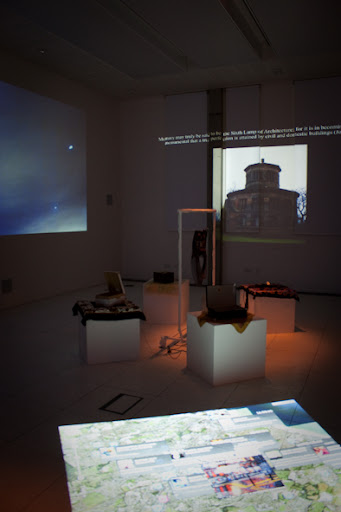
Our goal became an installation, which was exhibited at Inspace on the 13th of December. Photos coming soon! This consisted of four boxes, metaphors for memory, and a wall hanging, each intended to explore a different aspect of the elusive theme. We ended up with Woven Memories (Liz's beautiful wall hanging), Spatial Memories (Katherine look at historical memory stores), Digital Memories (guess who), Tidal Memories (Tina's view on the insubstantial nature of memory) and Fluid Memories (Agnese's investigation of social nostalgia). Upon opening each the four boxes, projections trigger onto surrounding walls, enveloping the visitor in the work.

Although I had an idea of wanting to use social media as part of the project, it was Katherine's idea of physical records of memory (memory spaces) that particularly inspired my approach; this prompted me to think of how in the present day a subset of this is virtual memory spaces. An initial idea was to join Katherine on one of her photo taking expeditions around Glasgow and whilst she took photos of physical memory spaces, I would check-in to them using Foursquare, creating a connection between the historical physical and the contemporary virtual. Other commitments meant I was unable to go to Glasgow on the date planned, unfortunately, and this idea wasn't pursued.

Having decided that we would each dedicate something physical to the aspect we had chosen to consider, I sourced a box, RAM and old maps and was pleased to entrust the decoration to Liz who is far more proficient at making things pretty than me. (I absolutely loved the outcome).

Tina and I applied our technical abilities to learning the basics of Max/MSP and how to use Arduino boards. I am particularly pleased about our decision to make the installation interactive; I learnt a lot and a door that I didn't previously know the location of has now been opened to me. The use of Arduino stuff is something I will definitely investigate further in the not-too-distant future.

I knew not to be too prescriptive from the outset, as what I was building would evolve as I discovered things I could and couldn't do. I dropped Foursquare for the final outcome because the output wasn't that interesting, and concentrated instead on Flickr and Twitter. I went through several iterations using different methods to try to get around various limitations of the Google Maps API. Eventually I settled on the jQuery plugin GMap3; although I still hit a few stumbling blocks at the last minute that I had to botch around because of time pressure (using an AppleScript to refresh the page was not the most elegant of solutions, but the JavaScript just wouldn't work. It didn't make sense, I swear. It did, however, introduce me to AppleScript for the first time, and the power that lays behind that...).

The aesthetics of the thing could have done with a bit more work, but the amount of time I had to spend getting the script to technically work meant I was left with much less time and energy to focus on the appearance than I would have liked.

Last minute problems with hardware meant that we had to lose the interactive element of my box (mine was the last one we were due to wire up). This is in part what encouraged the change of location of my projection, however, and I think it was far more effective beamed on the floor than it would have been projected onto a wall. Plus, having it triggered and hidden by the opening and closing of a box seems unnecessary, and perhaps counter intuitive in hindsight, as during the exhibition people would watch the activity on the map for extended periods of time.

I enjoyed working on a project where artistic intention was more important than code quality, and a final outcome was not strictly defined. This gave me flexibility to explore and work outside of the scope of computer science boundaries that I'm used to. Though obviously creative thinking and outside-of-the-box solutions are highly encouraged in software development fields, there is certainly an underlying rigidity or 'way of doing things' that is absent when applying such technology in an artistic context. And if I do end up back in the 'official' computing world, I'm certain that the kinds of experiences I gain during ICP will massively enhance my skillset as a creative developer.

You can check out what I projected here. This has only been tested in Chrome - I cannot be held responsible for irregularities that may occur using other browsers :)

It's worth noting that there are some truly wonderful people who gave up their time, resources, advice and patience to help us out during the project. Couldn't have done it without them!

Et, voila:

Remember When..?

I'll link some more photos asap...

Monday, October 31, 2011

Nanowrimo: Pre-madness

I've never sat up and counted down to the first of November before.

In 2007 I used Nanowrimo as an opportunity to kick myself into writing some more of a novel I started many years ago (reaching 35k new words by the end of the month) and in 2008 I took part in earnest, came up with a totally fresh idea the night before and hit the fifty thousand, two hundred and twenty ninth word of Milo's World before midnight on the 30th. It was, quite simply, the best feeling.

In both 2009 and 2010, my degree objected strongly, and I didn't even try.

This year, I know what being too busy to take part feels like, and I know what missing out feels like. But I also know what taking part feels like, and I know what winning feels like.

This year, I'm writing an old idea in a new way. A short story from around 2007 sparked novel scribblings in 2009, which got left to fester. Looking at these scribblings with eyes two years older, I plan to take the core concept and solidify it into something readable.

That's the theory, at least.

I'm terribly excited about creating some new lives. Then destroying one of those lives, and watching the effects cascade.

I'm mostly nervous because I've never written anything set truly in this universe before. Fifty percent of Milo's World was, and that fifty percent was from the point of view of a child with an enormously vivid imagination, so that doesn't really count.

A good chunk of Currently Untitled will be set inside the main character's head; a head which is subject to the physics and realities of this universe regardless of how much her mind tries rebel against them.

Her name is Harriet, by the way, and her little daughter is Rosy. I'll probably tweet about them as real people, because for the next 30 days, they might as well be. Rosy's dad is called Zeke, and Harriet's inconsequential boyfriend's name is Paul, as far as I know. I'm also aware of the existence of Patrice, a panda with an eye patch, and Arthur, a tiny penguin.

I'll probably post some extracts here. But I can't post daily progress, because of various linearity issues that I may or may not elaborate on in time.

But now, I'm going to stare at the counter on the front page of the Nanowrimo site, and try to figure out that first line...

Saturday, October 29, 2011

Spells wear out

One of the first lessons Turald learned during his time at Castle Qythe was that spells wear out. They weaken, they lose their power, the more they are used. They were all taught this, he and his classmates, probably in their very first week of study. But few eight year olds take this kind of wisdom to heart. Most are keen to crack on with casting, and nobody thought to question why some of their oldest tutors never demonstrated even the simplest of enchantments.

For as long as he could remember, Turald had loved to explore dark places. He loved to see what was out of sight; to make known the unknown. When he was fifteen, he discovered a whole section of the castle's cellars that had been lost for centuries. To the delight of his wizened mentors, the expanse he found was filled with age-old liquor which had been promptly and enthusiastically excavated. It was from then that his freedom had been unofficially granted to roam and explore the castle grounds as extensively as he saw fit. Recognising his gift for discovery, Turald's studymaster, the ancient but sprightly Professor Chalmak, quietly overlooked Turald's disregard for out-of-hours and restricted-area rules that were strictly imposed upon the other students.

In a broom cupboard, Turald once found a mousehole that lead two hundred metres north and seventy four years into the past. One of the seniors had been able to use this to make peace with a long-dead, estranged father who had been in that classroom, all those years ago.

In the shadowy corner of the library marked 'secret', Turald had found the headmaster's daughter, missing for over forty years.

In a tunnel that he had found through crawling into a large oak chest, Turald uncovered a delicate glass vial containing the last breath of the first philosopher.

When Turald realised that his elders thought him special for his findings, he began to keep a diary of them. Through his diary entries, he noticed patterns in his actions. Or rather, repetitions. The shedding of light was the key. Illumination was all he needed to do to bring something once hidden out into the open. His ability to conjure just the right incandescence became his greatest gift. Thus, he practised with vigour.

Caves, caverns, abandoned ruins: Turald devoured their secrets, consumed their stories. He exhausted the castle grounds, graduated from the Qythe Academy, and ventured forth into the Olde Lande, searching without hesitation for doors to throw open. Eyes aglow with his own special kind of vision, he absorbed the mysteries of a world in shadow.

But spells wear out.

He recalled this first in a forest, under a bristling canopy so thick that the blackened foliage groping at his legs had long since found ways to sustain itself that did not rely on the land's pale sun. He could see the trinkets that had been stowed away by blind magpies in treetrunk nests; the hoards of stolen food secreted into the undergrowth by milky-eyed squirrels. And then, he couldn't.

The flicker in his vision was fleeting, but enough to panic Turald, just for a moment. Enough to make that first ever lesson come rushing back. Still young, still adventurous, Turald shook his concern aside.

Deeper in the forest, he found a well; a man-made hole into the earth, darker even than woods entombing it.

Why had man built such a thing so far into the shade? Turald could not resist.

He descended, uncovering a concealed tunnel with his brilliant sight. Time having vacated entirely, Turald followed the route that stretched before him. No magic nor mystery, nor hidden treasure presented itself, and the rhythm of his steps lulled him into a trance. He walked blind for many hours before he realised he was doing so.

A droplet of water striking the tip of his nose roused him enough for him to realise he saw nothing. Turald stopped. The sudden lack of motion was jarring, dizzying. Turald sat. Water seeped into the hem of his robes, and he sat. Years of advice, words of warning, from teachers, mentors, elders, echoed through his mind.

Spells wear out.

Spells lose their power. Lose their potency. Lose their meaning.

Save the important spells for when you need them the most. Best to leave this world with a spell in your heart, than to leave it because your spells have run out.

Turald's light had run out, so he sat.

Thursday, October 06, 2011

Interactive-Bliction: > Investigate door.

> Investigate door.

Your eyes are drawn again to the marks on the small door, and you squint, taking a tentative step forward. A small cloud of powder rises around your foot, and a floorboard creaks. The creak is low, and to you, sounds welcoming. Like the house is inviting you in.

Encouraged by this, you continue. You have to watch out for the things cluttering the floor, and step carefully around an upturned plastic chair. That obviously wasn't part of the original décor, and despite the heavy coating of dust, you assume it must have been left by the documentary crew. Your foot clacks against something heavy.

> Look at floor.

The dust makes everything the same dark grey, but there are distinct shapes that you can see. Several small plastic chairs are visible, laying on their sides or with their legs pointing into the air. A standing lamp with a wide shade has fallen over at the foot of the stairs, to your left. There's a knee-hight rectangular box against a wall to your right, with what looks like a padlock hanging from the front, and beside it lie pieces of a large and once-ornate vase. At your feet is something long and narrow, and a glimmer of metal peeks through the dust. When your foot made contact, it felt pretty solid. You kick it again to roll it over, and dust peels away to reveal a brassy candlestick holder.

> Take candlestick holder.

You pick up the object, about half the length of your forearm. The metal is cool, but surprisingly not cold. Feeling like you need a souvenir, you tuck it into your coat pocket, and continue to pick your way across the hall.

> Inventory.

In your coat pockets you have the candlestick holder, half a bar of Dairy Milk, and the keys to your flat. In your trouser pocket is your mobile phone, which is turned off so your friends won't disturb you, and some change.

> Investigate door.

The small door is in front of you, and to your left is the sturdy looking bannister that runs up the side of the staircase. You could touch the bannister and the wall to your right at the same time, if you stretched out your arms. It's harder to see because you're no longer in direct line of the light from the entrance (which you left open), but you lean to inspect the front of the door. Cobweb trails curl around your finger tips as you run your hand down the dark wood. You can feel carvings on the surface, and blow and swipe at the dusty layer until the patterns are no longer so obscured.

You suppress a splutter at the thick and itchy air you're breathing. Some of the shapes carved into the door feel like cogs, but there's something else as well. Something winding, with a shape more organic. You only wish you could see all of the details.

Your wandering hand finds a wooden protrusion at waist height, and you try to turn the handle. It moves stiffly, but the door itself doesn't budge. Carefully, you lean your shoulder against it and push harder, but to no avail.

> _


[What do you do next? Comment!]

Wednesday, October 05, 2011

Fiction: The Hero of Monarar

[February 2009]

“Ours is but a small existence. We are but simple people. On this planet of ours, superheroes were but stories. Until today. We are gathered here to give thanks to the new Hero of Monarar, the almighty Ora. No-one knows from whence he came or where he goes. No-one knows how it comes that he moves so fast, predicts events with such precision. No-one knows why he has no tail, why his skin is dark, why his ears are sideways on his head. But it is to him we owe our utmost gratitude. It is he who freed us – who will continue to free us – from those that seek to imprison and enslave.

“We must support him as he travels our planet, rescuing villages, saving families.

“Here is to Ora the tailless, Ora the Hero of Monarar!”

The applause was deafening.


“Why didn’t I take the gloves?” Ora mumbled to himself. The rock was grazing his palms as he scrambled up the near-vertical cliff face.

“Because you’re a moron,” replied his subconscious. “Oh, I won’t need gloves. It’s not like I’ll be going anywhere cold, or, or doing any climbing. Moron.”

“Shuddup,” Ora spat. “Either shuddup or get out of my head and help, why dontcha? Huh?”

“Hows about you keep climbing, how about that? Oh, watch out.”

The blast of a laser smacked into the rock an arm’s reach above his head, and Ora ducked in time to dodge the heap of dislodged stone that tumbled down onto him.

“Oh some sixth sense you are. Warn me about a laser blast that’s already hit the rock. Nice work.”

“I warned you! It didn’t hit you, did it?”

“Waste of good coin you were. ‘Revolutionise your life’ my rear end. Just a pity you don’t come with a mute function,” Ora continued to grumble as he climbed. His subconscious reluctantly helped guide his limbs, warning him before he put his weight on unsteady outcrops, or grasped at stones that were not well attached to the surface, and occasionally to hesitate in time to avoid the lasers of those that were targeting him.


In the village, children were crying for their mothers. Mothers they could see, but not reach. A wall of men with guns divided the room into three sections; one for the mothers, one for the boys and one for the girls.

The men had once been fathers, husbands, sons, but now were faceless, armoured robots, unrecognizable to the ones they had once loved. They were hardly men at all.


Two days ago, Millsy and her brother had been collecting berries on the outskirts of the village. Her brother had paused for a rest, falling asleep by a bush beneath the warm, afternoon sun, and Millsy had wandered off alone, in search of adventure.

As she skipped further and further from the village boundaries, her mother’s words had begun to echo through her mind.

“Stay together when you’re out now. When you’re on the edge of the village, always keep one eye on the horizon. Keep a lookout, and if you see them coming, you run back and warn us all so we can get ourselves hidden, you understand?”

No-one had bothered to explain to Millsy exactly who them was, but she had caught enough glimpses of the news over the past few weeks that she knew that village after village on her tiny planet were disappearing off the map.

Her brother said it was invaders from outer space, and that had scared her until he had pulled her tail and run away, giggling “no such thing! No such thing! Millsy believes in aliens, there’s no such thing!”

And so despite her mother’s warnings, Millsy wandered away from the village, encouraged by her childish confidence that there were no alien invaders, and so nothing could be coming that was a danger.

When she saw the lights on the horizon, she stopped to watch. Darting, flashing beams. Bright colours, sparkling, glimmering, dashing through the sky and across the ground. Her neck craned farther and farther back as she watched those in the sky. Soon they were above her and surrounding her. There were straight flashes, like lightning; curling spirals of colour; pulsating circles and tiny pinpricks in the sky.

They overtook her, and Millsy spun around at once, chasing them back towards the village, not wanting to miss out on the display.


“You still haven’t justified why I paid so much for you,”

“Duck – incoming, eleven o’clock. Because I’m the best. There are no other warning systems like a sixth sense.”

“So far you’ve just been an annoyance.”

“Oh, and all those laser blasts, you could have dodged without my help?”

“I wouldn’t be here at all if it wasn’t for you. I’d still be enjoying myself on the Fourth Moon of Rasta.”

“You’re blaming me for your insatiable need to try new, mind-altering technologies? It’s my fault that you got me installed in the first place? And where… Not that one, it’s loose. And where did you get me installed, again?”

Ora mumbled.

“What was that? A back alley in Rasta’s infamous Flea Market? I’m certain you only have yourself to blame if I’m not what you expected.”

Ora growled. “Look, are we nearly at the top yet?”

“Not too far now.”

Then the device attached to his belt began to beep slowly, and Ora smiled. “Right you are.”

The beeps became more high pitched and more frequent as he continued to ascend. The relief was enormous when he could finally see the top of the cliff.


Millsy was whimpering alongside the others. She could see her mother across the room, but her brother was not to be found, and this upset her more.

A small arm snaked around her shoulders. Her best friend, Lella.

“Don’t cry Mills. You believe in the Hero of Monarar, don’t you? You know he will come to rescue us. He’ll set us free and put the men right again, just like he did in the other villages. It was on the news, my Mummy said. You’ll see.”


“How many more do I need?”

“Just one.”

“Really?”

“Yes, really. But what am I, your secretary? You shouldn’t rely on me to know these things for you, I’m an extra sense not more memory.”

“Well you might have to start learning to be memory, it’s a damn sight more useful than whatever else you do, and I’ve already gone over the maximum safe number of extra memory installations I can have.”

Ora heaved himself the last few inches of the climb and rolled over the ground at the top, breathing heavily.

“Move a foot to the left.”

He obeyed at once, rolling out of the way of yet another laser blast.

“Haven’t they given up yet,” he grumbled.

“Apparently not,” replied his mind. “Maybe you should find some shelter while you work out where the next device is.”

He pulled out his frantically beeping scanner. “Whatever, it can’t be far.”

Ora stood up, trusting his sixth sense to warn him of any more incoming lasers, and scanned the landscape. He could see buildings in the distance.

“Looks like they’ve got a fireworks show or something going on over there like at the last place. For a backward developing planet, they sure are celebrating a lot.”

“You should run,” suggested his subconscious, and Ora complied.


“Of all the planets to crash on, I not only hit a backward one, but a backward one that keep their nuclear cells inside yooge great fireworks machines.”

“Did it occur to you that the cells might be powering the fireworks machines?”

Ora was lying flat on his belly beneath what appeared to be a carpenters workbench. The workshop had apparently been cleared out – equipment heaped carelessly against the walls – to make room for the enormous multi-faceted machine in the centre. It was shooting out streak after streak of light in every direction. The beams rebounded off walls and furniture until they escaped through windows, or through the increasing number of holes in the walls.

The machine was slightly translucent, and Ora could see the power source he needed behind a series of hinged flaps leading to the heart of the thing.

“Here we go again.”

“You shouldn’t steal.”

There was a pause.

“Sorry,” said his subconscious. “Still a bit of official programming in me. I’ll work on it.”

Ora rolled his eyes and began to creep forwards. He had ordered a fully stripped down version of the sixth sense; it was all very well programming morals into mindware, but it didn’t half screw them up in conflicting situations.

A number of the women leapt to their feet, squealing and crying as the not-men moved to surround the small huddle of boys. The terrified lads were ushered to stand and guided slowly out of the room. The mothers wailed, pushing against the unmoving wall of men as they tried to reach their children. The boys themselves were silent, too terrified even to cry, panicked eyes staring back for one last time at their mothers and sisters before they were lead across a courtyard to the carpenters workshop.


“There are people coming.”

Ora froze. He had got through two of the compartment doors – there were just two more layers between his hand and the nuclear cell. His fingers brushed the third door, searching for the minuscule lock.

“I can do this. I can’t stop now.”

“It’s too late for you to hide now. But they won’t see you from the doorway. Just hurry.”


The first boy was pushed in front of the machine. He stood there, trembling, staring up at the dark, hulking construction. It was spewing sheets of light from every surface. Ora could roughly make the lad out through the semi-transparent innards of the machine. Nothing else seemed to be happening as Ora scrabbled frantically with the third lock, breaking it, reaching further in to move on to the fourth.

The boy flinched as a rebounding streak of light hit him in the chest. Ora did not see the child crumple to the ground, or begin to twitch as plates of armour appeared from nowhere, sliding themselves over the small limbs. The boy became upright as the armour covered him. He was standing by the time a helmet grew over his head. Then he walked stiffly, as if controlled by strings, to join the ranks of the other not-men.

The next terrified child was pushed into position.

Ora had missed the entire transformation, squinting upwards with his tongue sticking out as he worked the fourth and final lock.

The lock broke, the door swung in, and he pushed his arm further into the machine, straining to wrap his fingers around the cell.

The second boy, hands over his mouth as he awaited his fate, caught sight of movement through the machine. He saw the hand in the centre, followed the arm back to a face wrought with concentration.

His eyes widened. “Ora, Hero of Monarar,” he breathed. The stories were true. The legendary hero was here, was going to save him, as he had saved so many others. The lad watched in awe as Ora’s hand closed around the heart of the lightning beast, and wrenched it directly from its body. The beast shuddered and died, spitting out a final few shards of light as it did so. The not-men crumpled to the floor, armour plates dissolving into nothing as they retransformed.

The boy cried in relief and turned to the others to tell them what he had seen – who he had seen.


“Leggit!” Shouted Ora’s both conscious and subconscious simultaneously, and the hero bolted out of the workshop, back in the direction of his ship.